Scientists in Scotland have identified a 407-million-year-old fossil as part of a completely extinct branch of life. The organism, known as Prototaxites taiti, grew up to eight meters tall and once dominated landscapes before trees took over. The fossil came from the Rhynie chert near Rhynie in Aberdeenshire and is now part of the National Museums Scotland collection in Edinburgh. Researchers reached this conclusion after studying its structure and chemistry, which set it apart from fungi and plants. The find dates back to the Early Devonian period, a time when life was making its first big steps onto land.
Background
The Rhynie chert is one of the oldest known sites with preserved land ecosystems. It formed around 407 million years ago when hot springs deposited silica that locked in plants, fungi, and early animals in fine detail. This site has given scientists a clear window into a world before modern forests existed. Land plants back then were small and simple, nothing like today's trees.
Prototaxites first puzzled researchers in the 1850s. Fossils showed tall, trunk-like structures up to 26 feet high scattered across sites from North America to Europe. For over 165 years, experts debated what they were. Some called them giant fungi. Others thought they might be early trees or rolled-up mats of algae. No living relatives matched them, which made the mystery harder to solve.
The Devonian period marked a huge shift for life on Earth. Plants started growing taller and forming the first forests. Animals moved from water to land. In this mix, Prototaxites stood out as the biggest organism around, reaching heights that dwarfed everything else. Its fossils appear in rocks from 420 to 370 million years ago, then vanish completely.
Key Details
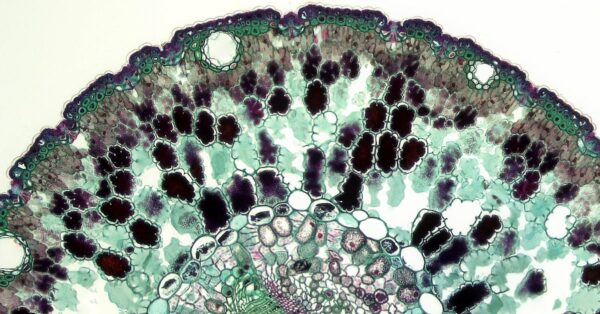
The new study focused on the largest known Prototaxites taiti fossil from Rhynie. This specimen measures 5.6 centimeters wide and runs through a 6.9-centimeter block of chert. It was incomplete at both ends, suggesting the full organism was even bigger. Researchers cut thin sections and examined them under microscopes.
Structure and Chemistry Findings
The fossil has a network of tubes of different sizes, including some less than one micrometer across. Dark spots inside, called medullary spots, turned out to be dense tube clusters. These features do not match any known fungi, which have different cell wall setups and growth patterns.
Chemical tests added more clues. Using infrared spectroscopy, the team compared Prototaxites to fungi from the same site. Fungi showed chitin signatures in their cell walls, a common marker. Prototaxites lacked those. It also missed perylene, a compound linked to fungal pigments found in other Rhynie fossils.
Machine learning helped sort the data. A model trained on Prototaxites samples correctly separated it from over 30 other fossils with 91% accuracy. The results pointed to unique compounds, perhaps like an ancient version of lignin, the stuff that stiffens plant cell walls today.
“It’s really exciting to make a major step forward in the debate over prototaxites, which has been going on for around 165 years. They are life, but not as we now know it, displaying anatomical and chemical characteristics distinct from fungal or plant life, and therefore belonging to an entirely extinct evolutionary branch of life.” – Dr. Sandy Hetherington, research associate at National Museums Scotland
The fossil joined the national collection after this work. It came from old blocks held at the University of Aberdeen. Preservation in chert kept its 3D shape intact, unlike flatter fossils elsewhere.
What This Means
This discovery rewrites the story of early land life. Before Prototaxites, scientists pictured bare ground with tiny plants and fungi. Now, giant towers up to 26 feet high filled the scene. These organisms may have been the first to reach such sizes on land, acting like the skyscrapers of their time.
Prototaxites likely played key roles in ecosystems. Its height could have shaded the ground below, changing how light and moisture worked. It might have housed small animals or fed early herbivores. Without modern groups to compare it to, we can only guess at its lifestyle—maybe it absorbed nutrients from the soil like fungi, or photosynthesized in some odd way.
The extinction of this lineage around 360 million years ago lines up with the rise of true forests. Seed plants and ferns took over, pushing out these giants. This shift helped build soil, release more oxygen, and set the stage for bigger animals.
For paleontology, the study shows how new tools can crack old puzzles. Synchrotron imaging and molecular analysis revealed details invisible before. The Rhynie chert holds more material for future work, including machine learning on other fossils.
“The Rhynie chert is incredible. It is one of the world’s oldest, fossilised, terrestrial ecosystems and because of the quality of preservation and the diversity of its organisms, we can pioneer novel approaches such as machine learning on fossil molecular data.” – Dr. Corentin Loron, from the UK Centre for Astrobiology
This extinct branch highlights life's creativity. Complex multicellular organisms tried many forms early on. Some paths led to today's plants and fungi. Others, like Prototaxites, died out, leaving only fossils to tell their tale. The find reminds us that Earth's history holds more surprises in its rocks.