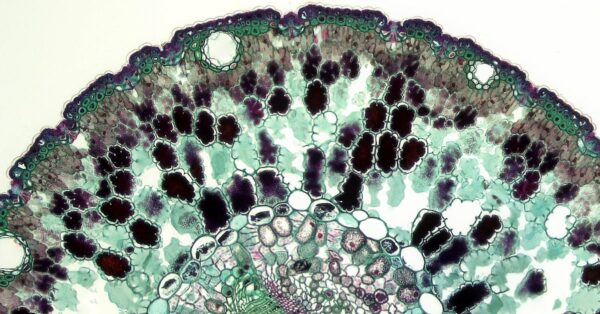
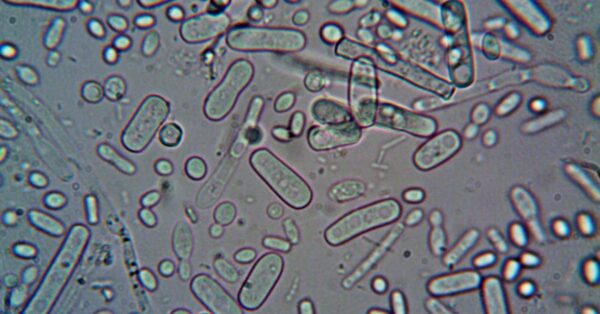
A 26-foot-tall fossil discovered in Scotland has been confirmed by researchers as something far stranger than previously thought: an organism that belongs to an extinct form of life with no living relatives anywhere on Earth today. The discovery, announced this week, ends nearly 200 years of scientific debate about what this mysterious structure actually was.
The fossil, called Prototaxites, dates back 407 million years and was found in the Rhynie chert, a rare rock formation in Aberdeenshire. For generations, scientists struggled to classify it. Some thought it might be a rotting conifer tree. Others believed it was a giant fungus. Now, after detailed chemical and structural analysis, researchers have concluded it was neither.
Background
The history of Prototaxites is one of scientific confusion. The fossil was first collected in 1843, and over a decade later, Canadian scientist J.W. Dawson examined it and suggested it might be a decaying conifer. Over the following years, researchers repeatedly misclassified the organism, unable to fit it into any known category of life.
The Rhynie chert itself is one of the world's most important sites for studying early life on land. The rock formation, which dates back 407 million years, preserves fossils with exceptional detail, capturing organisms in microscopic clarity. This preservation quality proved important for the latest research.
During the Devonian period, when Prototaxites lived, Earth's landscape was changing dramatically. Plants were experimenting with new forms, early forests were beginning to emerge, and animals were starting to adapt to life on land. Against this backdrop, Prototaxites stood as a giant anomaly.
Key Details
Researchers from the University of Edinburgh and National Museums Scotland led the analysis of new fossil samples. Using advanced chemical analysis and detailed structural comparisons, they examined the composition and internal structure of the organism with unprecedented precision.
The findings were clear: Prototaxites was chemically distinct from fungi living at the same time, and its structure differed fundamentally from any known fungus. Chemical testing showed the organism lacked perylene, a biomarker found in fungi. The molecular fingerprint of Prototaxites simply did not match anything else in the fossil record.
What Made It Unique
Prototaxites was not just unusual in its chemistry. Its sheer size made it the largest known organism on land for millions of years. The organism was composed of interwoven tubes and had a roughly cylindrical shape. Some specimens found in the Rhynie chert extended several inches in width, and researchers believe these were only fragments of much larger structures.
"Prototaxites therefore represents an independent experiment that life made in building large, complex organisms, which we can only know about through exceptionally preserved fossils," said Laura Cooper, a doctoral student at the University of Edinburgh who worked on the study.
The research team concluded that Prototaxites must have originated from an evolutionary path that eventually went extinct without branching further or leaving any descendants. It belonged to what scientists now call an "extinct eukaryotic lineage," meaning it was a complex organism that evolved independently and then disappeared completely.
The study was published in the journal Science Advances on January 21, 2026.
What This Means
The discovery changes how scientists understand the early history of complex life on Earth. For millions of years before forests and familiar land animals took over, Prototaxites dominated certain ecosystems in ways we are only now beginning to understand.
The findings also highlight how little we know about Earth's distant past. Exceptional fossils like those found in the Rhynie chert can completely reshape our understanding of ancient life. Without the remarkable preservation of these Scottish rocks, Prototaxites might have remained misclassified for another century or more.
For scientists studying how life became complex, the discovery offers a humbling lesson: evolution experimented with forms of life that left no trace in the modern world except for fossils. Prototaxites was one of those experiments, a giant organism that thrived for millions of years before vanishing completely, leaving behind only questions and stone.