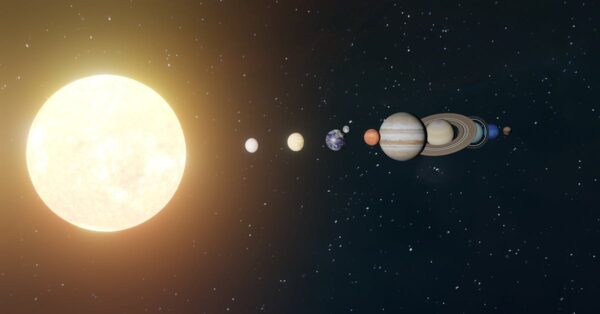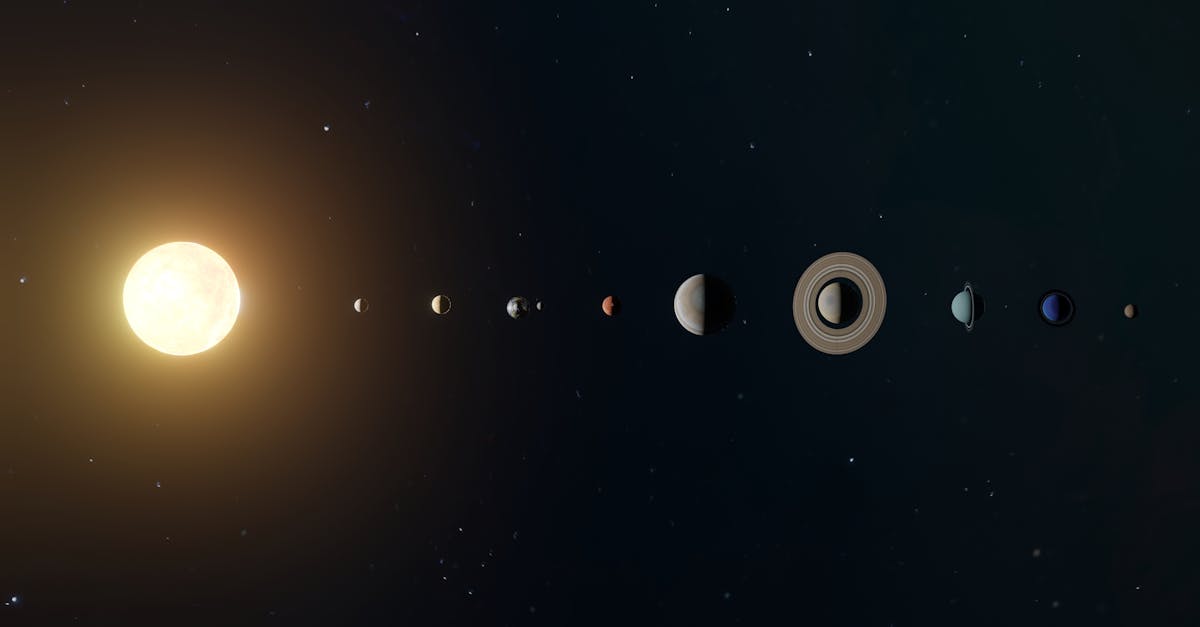
When you look at our solar system from above, something striking becomes immediately obvious: all the planets move along nearly the same path around the Sun, as if they were rolling on an invisible flat surface. Mercury, Venus, Earth, Mars, Jupiter, Saturn, Uranus, and Neptune all stay within a thin band of space called the ecliptic plane. This is not a coincidence, but rather the result of how our solar system formed billions of years ago.
For centuries, this alignment seemed almost too perfect to be real. Early astronomers noticed it, but struggled to explain why planets would organize themselves so neatly. Today, scientists understand that this arrangement tells a story about the violent and chaotic birth of our planetary system, when gravity reshaped everything into the orderly system we see today.
Background
When the solar system was born roughly 4.6 billion years ago, it started as a spinning disk of dust and gas surrounding the young Sun. This disk was not perfectly flat—it had bumps and variations. Yet as the planets formed and grew within this disk, gravity worked to flatten and align their orbits.
The key to understanding planetary alignment lies in how planets form. All eight planets originally formed from material that orbited relatively close to the ecliptic plane. As these early planets grew larger, their immense gravity began pushing and pulling on smaller bodies around them. This gravitational jostling was especially intense when the giant planets—Jupiter and Saturn—formed. These massive gas giants acted like cosmic bulldozers, shoving other objects around and gradually forcing planetary orbits into alignment.
Over millions of years, this process of gravitational interaction created what scientists call orbital equilibrium. The planets settled into stable orbits that all shared roughly the same plane. While each planet has a slightly different orbital inclination—the angle at which it tilts from the ecliptic—these differences are so small that all eight planets appear to move along nearly the same path.
Key Details
The planets do not all orbit in exactly the same plane. Mercury tilts at about 7 degrees from the ecliptic, while Venus sits at roughly 3.4 degrees. Earth, by definition, sits at zero degrees since the ecliptic plane is defined by Earth's orbit. The outer planets have even smaller tilts. These variations exist because the solar system's formation was messy and unpredictable, with countless collisions and gravitational interactions that slightly disturbed each planet's path.
When viewed from the Sun's north pole, all planets orbit in the same counterclockwise direction. This shared direction is another clue to their common origin. The planets inherited this direction of motion from the original spinning disk of material that surrounded the young Sun. As gravity reshaped their orbits, it could change their inclinations, but it could not easily reverse their direction of travel.
Why comets break the pattern
While planets follow this orderly arrangement, comets tell a different story. Long-period comets, which take tens of thousands of years to complete a single orbit, come from all directions. They swoop in from above and below the ecliptic plane, sometimes traveling backward relative to the planets' motion. These comets were not formed in the inner solar system like the planets. Instead, they originated in the distant outer regions and were later scattered into wild orbits through gravitational encounters with the giant planets.
Recent research has revealed something surprising about these scattered comets. When scientists analyzed the orbits of long-period comets, they discovered that the comets' farthest points from the Sun tend to cluster around two planes. One is the familiar ecliptic plane where the planets live. The other is a previously unknown "empty ecliptic," tilted at the opposite angle. The Milky Way Galaxy's gravity, though subtle, helps explain this pattern. The galaxy's gravitational field gently pulls on distant comets, nudging their orbits toward these two special planes.
"The sharp peaks are not exactly at the ecliptic or empty ecliptic planes, but near them. An investigation of the distribution of observed small bodies has to include many factors. Detailed examination of the distribution of long-period comets will be our future work."
This finding suggests that models of solar system formation are fundamentally correct. Long-period comets did form near the ecliptic, as theory predicted, and were later scattered by planetary gravity into the diverse orbits we observe today.
What This Means
Understanding why planets orbit in nearly the same plane reveals how fragile and interconnected our solar system truly is. The alignment is not permanent or unchanging. Over billions of years, continued gravitational interactions between planets gradually shift their orbits. Earth's orbit, for example, wobbles slightly over long time scales due to the gravitational pull of other planets.
This research also helps astronomers understand planetary systems around other stars. Many distant planetary systems show very different arrangements, with planets in highly tilted or even retrograde orbits. By comparing these alien systems to our own, scientists learn how different conditions during a star system's birth lead to different outcomes.
The discovery of the empty ecliptic plane demonstrates that our solar system is more complex than it first appears. Even the empty space around us contains evidence of gravitational forces at work. As new telescopes like the Legacy Survey of Space and Time begin mapping the sky with unprecedented detail, scientists expect to uncover more secrets hidden in the orbits of distant objects. Each discovery adds another piece to the puzzle of how our solar system came to be.