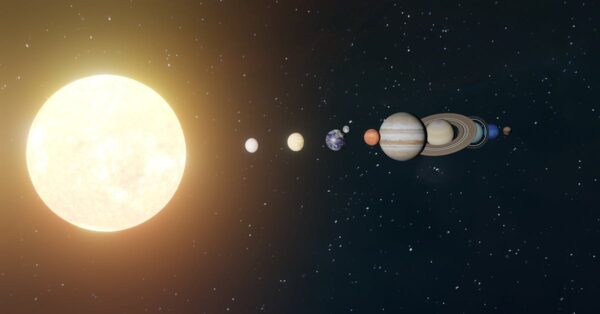
The eight planets in our solar system circle the Sun in paths that lie almost flat, like marbles rolling on a table. This setup comes from the birth of the solar system about 4.6 billion years ago, when a cloud of gas and dust collapsed and spun into a disk. That disk gave birth to the Sun at its center and the planets around it, all following the same basic plane.
Background
Long ago, a huge cloud of gas and dust floated in space. Gravity pulled it together, and as it shrank, it started to spin faster, much like a figure skater pulls in their arms to speed up. This spinning cloud flattened into a wide disk, with most material circling in the same direction. The Sun formed from the dense middle of this disk, and planets grew from clumps of dust and rock in the flatter outer parts.
Earth's orbit defines the main plane, called the ecliptic. All other planets stick close to it. Mercury tilts the most at seven degrees off this plane. Venus sits at 3.4 degrees, Mars at 1.8 degrees, and the outer giants like Jupiter, Saturn, Uranus, and Neptune stay within two degrees. Pluto, now a dwarf planet, strays farther at 17 degrees, which helped downgrade its planet status.
This flat arrangement holds for most of the solar system. Asteroids in the main belt between Mars and Jupiter mostly follow the same plane too, though some like Pallas tilt at 35 degrees. Comets tell a different story. Many come from far out in the Oort Cloud and can loop in from wild angles, even backward compared to the planets.
Key Details
The disk model explains the plane's origin. Dust particles in the early cloud bumped into each other and stuck, forming pebbles, then rocks, then planetesimals. Gravity smoothed out their paths, pulling everything toward the disk's middle plane. Gas giants like Jupiter grew fast from vast amounts of hydrogen and helium, their gravity tugging smaller bodies into line.
Small differences exist because the system is not perfect. Early crashes between growing planets knocked orbits slightly askew. Jupiter's pull reshaped paths for inner worlds like Mars. Over time, these forces settled into a steady state, with planets orbiting the same way the original cloud spun—counterclockwise if viewed from above the Sun's north pole.
Orbital Tilts by Planet
Here is how each planet compares to the ecliptic:
- Mercury: 7 degrees
- Venus: 3.4 degrees
- Earth: 0 degrees (by definition)
- Mars: 1.8 degrees
- Jupiter: 1.3 degrees
- Saturn: 2.5 degrees
- Uranus: 0.8 degrees
- Neptune: 1.8 degrees
These tiny tilts mean from Earth, planets always appear along a narrow band in the sky, the zodiac path astronomers have tracked for thousands of years.
"The planets orbit in nearly the same plane because they formed in a spinning disk that flattened under gravity," said Dr. Elena Vasquez, an astronomer at the Center for Astrophysics.
Interactions keep the system stable today. Tides from the Sun and planets dampen wobbles over eons. Moons around gas giants align with their planet's equator, not always the ecliptic, because they formed in mini-disks around those worlds.
What This Means
This flat plane makes the solar system easier to study. Telescopes spot planets as bright dots hugging the ecliptic line. Planet parades, where several line up in our evening sky, happen often because of this setup. Right now, Venus, Mars, Jupiter, and Saturn appear after sunset, spread across that familiar path.
The pattern hints at other systems. Telescopes like Kepler and TESS find exoplanets around distant stars, many in flat planes too. This suggests disk formation is common across the galaxy. But some systems show tilted orbits, perhaps from close stellar flybys or different birth conditions.
For Earth, the plane matters daily. It sets the seasons as our tilt wobbles against the ecliptic. Eclipses happen when the Moon's orbit, close to ours, crosses this plane just right. Without the flat disk, our nights might lack these predictable sights.
Scientists use the plane to hunt for threats. Near-Earth asteroids stick close to it, making them easier to track. Comets from outside can surprise with steep paths, demanding wider watches.
The invariable plane, a fixed reference from total angular momentum, sits even closer for most orbits. Neptune matches it best at 0.7 degrees. This deeper stability shows the system's deep roots in that first spin.
Looking ahead, missions like NASA's Europa Clipper will probe icy moons in the outer system, still locked to this ancient plane. Ground observatories map exoplanet tilts to test if our setup is typical or rare. Each find builds on the simple truth: one flat disk birthed our orbiting family, and echoes of it fill the stars.